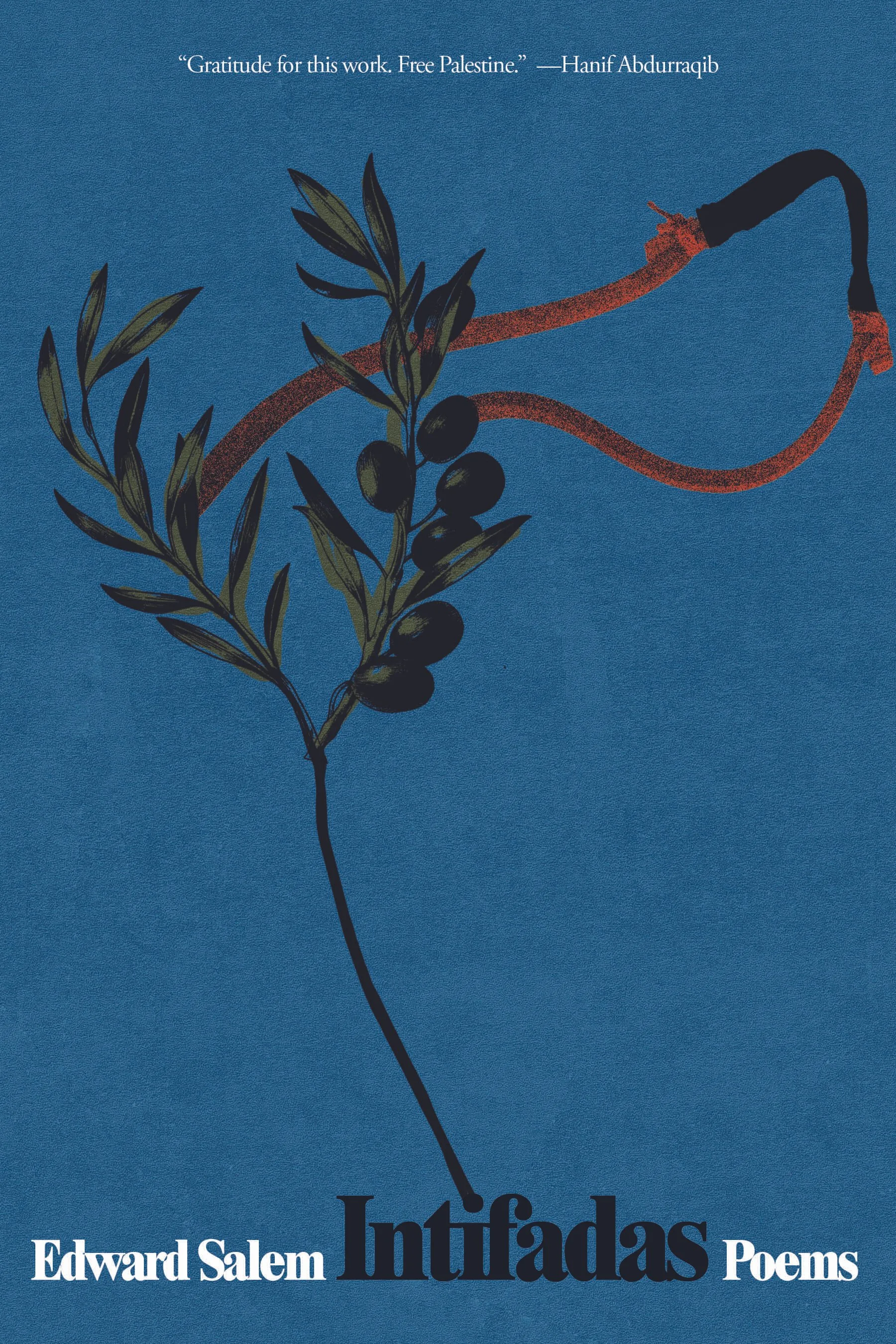
“By turns bitterly funny and wrenching, these poems demonstrate their meticulous craft through inventive forms and surprising, powerful language.”
—Publishers Weekly Best Books of 2026
“A daring, subversive sophomore collection, wracked with survivor’s guilt and righteous fury. . . Salem’s unforgettable poems serve as a requiem and a call to action.”
—Publishers Weekly (Starred Review)
“Absolutely essential reading during these uncertain times.”
—Diego Báez, Booklist (Starred Review)
“An antidote to a sentimentalized strain of ‘diaspora poetry’. . . What may seem to be a portrait of the ex-performance artist as affable edgelord turns out to be a way of capturing the tenuous place of a Palestinian American back in his homeland without obscuring the way that his Americanness, chosen or not, sets him apart. Underneath it all is a reckoning with the meaning of the longed for Third Intifada, the stakes and imperative of a transformative uprising even knowing the reprisals that will follow. It’s the event he’s far from alone in longing for.”
—Elena Comay del Junco, Poetry Project Newsletter
“Edward Salem is a perfect poet. He writes about everything including being Palestinian with an easy publicness, a ferociousness, a jadedness and a warmth—and he accomplishes the hardest part of a poem, the end, like a saint. His endings feel like asides in which everyone, if they want it, feels included.”
—Eileen Myles, author of A “Working Life”
"This is a book of poems steeped in tenderness and love for a place, for a people. There is also a richness, a depth of humanity that shines through in the work, and the desire to uplift and protect that humanity might drive you to deep affection, which may flip the switch of rage, which may, I hope, flip the second switch of action. Gratitude for this work. Free Palestine.”
—Hanif Abdurraqib, author of There's Always This Year
"If empire could become a witness to itself, it would look like Salem's work—a beautiful soul who has somehow managed to condense a tremendous amalgam of our collective history and culture without denying either part's intimacy or violence."
—Marwa Helal, author of Invasive species
“Salem’s writing rings with an honesty that I found intimately provocative yet subtle. . . It’s also funny.”
—Ottessa Moshfegh, author of My Year of Rest & Relaxation
“Edward Salem’s Intifadas is a remarkable achievement, one destined to become an American classic.”
—Michael Simms, Pittsburgh Review of Books
“We need iconoclastic poets right now. We need their hammers to break what we’ve come to expect and what we’ve neglected to question. Edward Salem’s Intifadas is a hammer against the iconography of empire and the lawlessness of official party lines; it is a golden, singing, self-doubting hammer.”
—Christopher Nelson, Green Linden Press
“These voice-driven narrative poems from Palestinian American artist Salem center on personal, political, and artistic acts of resistance.”
—Publishers Weekly, “Spring 2026 Fiction & Nonfiction Preview: Poetry Top 10"
“Intifadas asks complex questions about exile and return, collective responsibility and art-making in ways that invite readers in.”
—Laura Sackton, BookPage
Winner of the Kathryn A. Morton Prize in Poetry,
selected by Hanif Abdurraqib
Publishers Weekly Top 10 Poetry books coming out Spring 2026
A subversive collection about Palestinian resistance, liberation and art
Written across Palestine and its diaspora—from Gaza and the West Bank to the United States—Intifadas is a subtly transgressive poetry collection about uprising in its many forms—in art, politics, and in our most personal relationships. Furious, tender, and darkly funny, Intifadas asks what art can do in the face of catastrophe, and answers with poems that refuse easy consolations.

“If you’re feeling nauseated in this era of Instagram’s atrocity/frivolity juxtapositions, sick of grasping after agency as speech, protest, voting (and other opportunities for impact) are sabotaged, this debut collection is one I might prescribe like a gastric lavage.”
—Rosalie Moffett, Los Angeles Review of Books
“Salem requires his readers to rethink how and why they come to (Palestinian-American) poetry in the first place, and what quiet cultural-political structures have a vested interest in Palestinian-American verse being either epiphanic or redemptive. It’s the refusal of those poetic strategies, and thus the often-darkly-funny fuck-you to American liberalism, that make Monk Fruit such a distinctive and valuable collection.”
—Noah Warren, Fence
“The poems of Monk Fruit resist, in diction and attention, the impulse for a high lyricism. The book softens its own far-reaching intelligence with idiosyncratic obsessions, the cultural (pop and otherwise) ornaments of the everyday.”
—Christian Wessels, Cleveland Review of Books
“[A]t the crossroads of two traditions of the absurd, part Samuel Beckett monologue, part Wile E. Coyote. . . all the language that offends upstanding audiences and all the violence that apparently doesn’t.”
—Christopher Spaide, Literary Hub
“Nightboat has launched an important new poet and aesthetic project here. The book is simultaneously hilarious and hard-edged, bathetic and heartbreaking, and I would not be surprised to find Salem’s stature rising considerably over the coming months.”
—Christopher Kempf, Preposition
“If this is the future of political poetry, I welcome it.”
—David Starkey, California Review of Books
“A ground for new relationships, new politics.”
—Noah Warren, Cleveland Review of Books
“Monk Fruit plays in the space between the deadly serious and the seriously deadpan. . . Salem has a kind of aesthetic reverence for irreverence—moments of absurd and often crass juxtaposition open into revelation.”
—Peter Stuart, Michigan Quarterly Review
“Monk Fruit speaks to the immediacy of our current moment while also taking a 250,000-year lens to humanity, inviting readers to interrogate their place in it all—even, perhaps, without losing optimism entirely.”
—E Ce Miller, Four Way Review
“Reading Monk Fruit is like walking through a fun house strewn with banana peels. . . By turns horrifying and extraordinarily funny, Monk Fruit is an exploration of living with budding contradictions within the self and society at large.”
—Richard Hamilton, Rain Taxi
“Operating intertextually with a Godhead in its poetics of negation, Salem manages, paradoxically, to build possibility through persistent negations. Each time a line of argument becomes discernible, it’s quickly and forcefully wrought back around its own tail, creating coils of energy in refusal.”
—Ian U Lockaby, Poetry Daily
“Deftly deployed humor. . . employs a practice akin to the Situationist and Discordian approach of culture jamming.”
—mk zariel, The Anarchist Review of Books
“Salem has a confiding way of laying in details that clocks contemporary bleakness and absurdity with a sensitively tuned wit. Salem’s facility for storytelling, as well as his experience with direct action, shine through.”
—Chantal McStay
“Salem’s poems are must-reads, proceeding with a cleverly calculated off-the-cuff quality and a relentless, dry, weird wit. They spin absurdist nightmares of art and history, of links and screenshots and mediated engagement with atrocity, of the genocide against Palestinians and the many attendant erasures. Salem writes, astutely and acutely, of belonging, unbelonging, and the possibilities and impossibilities of solidarity. These poems are, in short, essential.”
—Natalie Shapero, author of Stay Dead
“Edward Salem’s first book is monumental. The collection reads at 180 bpm and keeps your heart rate there. The poems are inescapably memorizable, devastating, and tattooable. The voice is precise, imaginative, shattering, and somehow hysterical. This is an urgent book, a book to hold close, a book to memorize, a book to underline and line the inside of your eyelids. Read & repeat.”
—sam sax, author of Pig
“In Monk Fruit, Edward Salem’s sadomasochist poetic proclivities render death & sex as simultaneous, cyclic events beneath the shelling. ‘I use pliers to stretch your nipples / past the Apartheid Wall to Cairo.’ On loop, Monk Fruit’s death hedonism stretches across dream & wakefulness infiltrating every moment with the veracity of life & death as Palestinian. Salem’s razor wire sharp turns mark the reader with both the degradation of displacement & the inescapable complicity in gen0cide: ‘you were there / for all of it.’”
—Andrea Abi-Karam, author of Villainy
“Salem puts on display succinctly, humorously and, dare I say, beautifully, that life, with its attendant highs and lows, joys and sorrows, is really just a game—a deadly serious game.”
—Hayan Charara, author of Something Sinister